Is the Gosho* an Inspiration of Faith or a Modern Embarrassment?

Modern people would dismiss Nichiren’s “magical view,” and when we find ourselves doing that, it’s our loss.

* Gosho: The individual and collected writings of Nichiren (1222–1282).

When Skepticism Becomes a Reflex

Nichiren’s writings reflect a Kamakura-period world in which omens,1 cyclical signs,2 spiritual connection with heavenly beings, gods, or even Shakyamuni himself,3 and the reality of hell,4 were part of the shared symbolic landscape. Modern readers often react by dismissing these elements as superstition—and sometimes that skepticism is healthy. But skepticism can also become a reflex that prevents us from learning how faith functions in Buddhist practice: not as gullibility, but as a disciplined willingness to enter a teaching deeply enough to be changed by it.

The purpose of this article is to point out that modern people would dismiss Nichiren’s “magical view,” and that when we find ourselves doing that, it’s our loss. I’ve done this myself.

I doubt Nichiren would be any more welcome today than he was in his own time. I think we’d treat him like a crank, who entertained delusional ideas and offered a foolish, magical view of the world unworthy of serious consideration.

Things we’d categorize as “folk magic” like hand gestures (mudras),5 mandalas and objects of devotion like the Gohonzon,6 are presented in Nichiren’s writings and in the Lotus Sutra as gifts of spiritual significance. Modern embarrassment about these “odd” gifts is misguided. They increase our faith and we should trust them.

Nichiren’s era’s comfort with “instruments/signs” can be seen as compatible with (or even conducive to) deepening one’s connection with Shakyamuni7 and strengthening the faith needed to break free from the six paths.8

What ‘Healthy Skepticism’ Can’t Teach Us

A fair question follows: isn’t there a risk of being too believing? How much do we open to strange ideas before becoming irrationally gullible? That question matters, and I address it more fully in a separate article.9 For now, I’ll simply say this: skepticism is an important tool, and modern people are often well-trained in it. What we are less practiced in is being able to employ learning by faith.

Nichiren was a man of faith and one purpose for this essay is to defend the faith of Nichiren. Faith as a tool for learning new spiritual truth is critical for attaining Buddhahood in this lifetime. The qualifier Nichiren gives that activates the power of Nam-myoho-renge-kyo is “deep faith.”:

“If you chant Myoho-renge-kyo with deep faith in this principle, you are certain to attain Buddhahood in this lifetime.” (Writings of Nichiren Daishonin, Volume 1, page 4. Hereafter abbreviated “WND-1, page number.”)10

The Robe Problem: When the Text Sounds Absurd

In a study through my recent daily reading through the Writings of Nichiren Daishonin, I ran into a compact example of what I’m talking about. Nichiren writes  – without hesitation – about being born with a “robe.”

The monk Myōe (絹本著色明恵上人像, kenpon chakushoku Myōe Shōninzō) from Kōzan-ji, Kyoto dated to 13th century Kamakura period. Hanging scroll, 145.0 cm x 59.0 cm. Color on silk.

In his letter “Condolences on a Deceased Husband”, Nichiren wrote to the lay nun Myōhō:

“Of the six paths of existence, persons born into the first five, from the realm of hell to that of human beings, are all invariably born naked. Only those who are born into the sixth path, that of heavenly beings, are born wearing a robe. Thus, no matter what kind of sage or worthy person one is destined to be, so long as one is born as a human being, one invariably comes into the world naked. Even Bodhisattva Maitreya, who will succeed Shakyamuni in the future as a Buddha, was born in this way, to say nothing of other types of persons.” (WND-2, 765)

To a modern reader, the idea of being born wearing a robe can sound absurd. Yet Nichiren presents it plainly—as if it were simply part of how things are.

My goal here is not to reject intellectual honesty, or to deny the role of mythic realism and skillful means (upāya). Religious texts can be truth-bearing without being literal reportage. I believe it’s possible to be both intellectually honest and spiritually receptive. Still, the modern worldview trains us to process everything intellectually, and that can leave us weak in the muscles of faith and spiritual receptivity.

When reading texts written from the worldview of thirteenth-century Japan, I’ve found it useful to make a conscious choice to suspend judgment, just to see whether a passage yields insight I’d miss if I dismissed it too quickly (like a metaphorical jewel hidden in a robe, perhaps?).11

Unknowns and the Limits of “Real”

If we want to strengthen our “faith muscles,” here is one mental exercise that may help us resist the reflex to dismiss.

We should remember that in this Saha world, much lies beyond what we can directly see and measure.

Using everything that we have the ability to assemble, using all of our science, using all of our finest instrumentation, using every mechanism that we can devise, we know that approximately 68% of the energy in the universe is what is called dark energy. It’s called dark energy because we know it’s there; we haven’t a clue what it is. Using that same science and ability and instrumentation, we know that 27% of the universe is comprised of dark matter. We know it’s there because physics suggests its presence. We don’t have a clue what it is. The total of these two means that 95% of the universe we can detect is composed of things we cannot see, we cannot understand, we cannot comprehend. We detect and comprehend, at best, only five percent of all that exists using our best science and best instruments to examine the universe.12

On this world—just this world—depending upon the degree of humility that we acknowledge about our present understanding, about ~14% of Earth’s species have been described/indexed (with ~86% undescribed, estimates vary by group).13 Of the known life forms that we know about, humanity makes up no more than .001% of that life.14

I offer these examples not to equate Buddhist cosmology with modern physics, but to point to a shared humility: both acknowledge that most of reality lies beyond direct human perception.

Unknowns don’t prove any particular claim, but they do caution us against equating “unmeasured by my senses” with “impossible.” Imagine someone tells you they can see auras around people. Should I dismiss them as lying or delusional simply because I don’t see what they see? Or is it more honest to hold a middle position—neither credulous nor contemptuous—acknowledging that their experience may be real to them even if I cannot verify it with my own eyes?

Protection After Death, Accountability Now

A year after the letter to the lay nun Myōhō, Nichiren wrote again from Minobu in his “Letter to Jakunichi-bō,” and returned to the theme of a robe:

“But disgrace in this life is nothing. Of far greater concern is the disgrace that appears in the next life. Proceed to the place of practice of the Lotus Sutra, bearing in mind the time when you must face the wardens of hell, and the garment-snatching demoness and the garment-suspending demon will strip off your clothes on the bank of the river of three crossings. The Lotus Sutra is the robe that will keep you from disgrace after this life. The sutra reads, ‘It is like a robe to one who is naked.'” (WND-1, 994)

Now the “robe” becomes more than a cosmological detail; it becomes a vivid moral and spiritual image. The Lotus Sutra itself is described as a robe—protection against disgrace, and a safeguard as one faces the consequences of karma.

It’s worth considering Nichiren’s earlier statement that heavenly beings are “born wearing a robe.” If we take this statement seriously, and we also take seriously the identity of practitioners as bodhisattvas—Bodhisattvas of the Earth—then we are certainly beyond “the sixth path, that of heavenly beings” and we have indeed been born wearing “a robe”.

Nichiren continued describing this “robe”:

“Despite this fact, however, this man Shānavāsa was born wearing a wonderful robe called shāna. This robe of his was not stained by blood or other impurity. It was like a lotus flower that grows up out of a muddy pond, or the wings of a mandarin duck that are not wet by the water.

Moreover, as Shānavāsa grew older and larger, the robe bit by bit expanded in size. In winter it was thick, in summer thin; in spring it was green in color, but turned white in autumn. Since Shānavāsa was a man of wealth, he lacked for nothing, and in time he came to fulfill all the predictions that the Buddha had made concerning him. Thus he entered the Buddhist Order and became a disciple of the Venerable Ānanda. At that time, this robe that he had been wearing changed into monk’s robes of five-, seven-, and nine-strip widths.” (WND-2, 765)

I want to acknowledge the obvious possibility that some things are meant to be considered as symbolic or metaphorical. To simply label anything that seems outlandish as “mere metaphor,” can also become another way of refusing to engage. Nichiren himself does not pause to defend the claim or soften it; he writes as though it is straightforward fact.

Whether understood metaphorically (as karmic protection or spiritual identity) or literally (as an unseen dimension of existence), the image of an invisible robe invites us to reconsider how narrowly we define ‘real.’ Read symbolically or cosmologically, Nichiren’s robe references may remind us that practice itself is a form of protection—and that accountability and responsibility, not comfort, is the true garment of a bodhisattva.

The Shoulder That Bears the Work

The Lotus Sutra describes a ritual gesture that appears repeatedly: the participant bares one shoulder, kneels, and presses their palms together to honor the World-Honored One.

“At that time the bodhisattva Inexhaustible Intent immediately rose from his seat, bared his right shoulder, pressed his palms together and, facing the Buddha, spoke these words…” (The Lotus Sutra and Its Opening and Closing Sutras, p.339. Hereafter abbreviated “LSOC, page number.”)

In Burton Watson’s translation (from the Chinese), the gesture is described as baring the “right shoulder.” In a Sanskrit-based translation, the robe is explicit:

“Thereafter the Bodhisattva Mahâsattva Akshayamati rose from his seat, put his upper robe upon one shoulder, stretched his joined hands towards the Lord, and said…”15

Anciently, clothing was valuable, and most labor was manual. A bare shoulder could become calloused through work, and if scratched or cut, could heal. But a torn robe took effort and time to repair, and any injury to the garment would shorten its life. Therefore, clothing was protected from this daily labor when possible by leaving the weight-bearing shoulder uncovered.

This may suggest that in ritual, leaving the right shoulder bare was a symbol that there was still the need to carry a burden on the right side. The work was not done. In the Lotus Sutra, wherever we find this gesture of baring the right shoulder taking place, it appears to be an indication of those demonstrating the gesture that they are expressing a willingness to commit to whatever action and work may be required to attain the object of their request.16

Jewels Hidden in the Robe

From a modern “sophisticated” standpoint, it can be difficult to take seriously the world Nichiren inhabited—a world where “signs,” unseen beings, and vivid cosmological imagery were common. What important insights do we miss if we dismiss those elements as nonsense too quickly?

In our modern world view of sophistication, I think it is very difficult for us to entertain what was the common magical view of the world from the perspective of those who lived at the time of Nichiren in thirteenth-century Japan. Do we miss some important things that we might otherwise be enlightened by when we simply dismiss as nonsense strange things we read in Nichiren’s writings?

For me, there really are jewels hidden in these robes. And if you want to strengthen your own faith, I invite you to consider what might open up when you allow even Nichiren’s “odd” claims to remain on the table long enough to teach and enlighten you.

Download PDF version of this article here.


  1. “Why do I say this? Both the Buddhist and non-Buddhist writings make clear that omens will always appear before a certain destined event actually occurs. Thus, when the spider spins its web, it means that some happy event will take place, and when the magpie calls, it means that a visitor will arrive. Even such minor occurrences have their portents. How much more so do major events!” (Writings of Nichiren Daishonin, Volume 1, page 439-40. Hereafter abbreviated “WND-1, page number.”) ↩︎
  2. “In these twenty-seven years, however, Nichiren was exiled to the province of Izu on the twelfth day of the fifth month in the first year of Kōchō (1261), cyclical sign kanoto-tori, and was wounded on the forehead and had his left hand broken on the eleventh day of the eleventh month in the first year of Bun’ei (1264), cyclical sign kinoe-ne. He was led to the place of execution on the twelfth day of the ninth month in the eighth year of Bun’ei (1271), cyclical sign kanoto-hitsuji, and in the end was exiled to the province of Sado.” (WND-1, 996-97) ↩︎
  3. “From this time forward, the great bodhisattvas, as well as Brahmā, Shakra, the gods of the sun and moon, and the four heavenly kings, became the disciples of Shakyamuni Buddha, the lord of teachings.” (WND-1, 251) ↩︎
  4. “If I remain silent, I may escape persecutions in this lifetime, but in my next life I will most certainly fall into the hell of incessant suffering.” (WND-1, 239) ↩︎
  5. “Their hands form the mudra gestures, their mouths repeat the mantras, but their hearts do not understand the principles of Buddhism.” (WND-1, 169) ↩︎
  6. In Nichiren Buddhism, the Gohonzon most commonly takes the form of a calligraphic mandala—a scroll inscribed with Chinese and Sanskrit characters. Nichiren inscribed it to embody the essence of the Lotus Sutra and the law of Nam-myoho-renge-kyo (the fundamental chant in this tradition).
    “Never seek this Gohonzon outside yourself. The Gohonzon exists only within the mortal flesh of us ordinary people who embrace the Lotus Sutra and chant Nam-myoho-renge-kyo. The body is the palace of the ninth consciousness, the unchanging reality that reigns over all of life’s functions. To be endowed with the Ten Worlds means that all ten, without a single exception, exist in one world. Because of this it is called a mandala. Mandala is a Sanskrit word that is translated as ‘perfectly endowed’ or ‘a cluster of blessings.’ This Gohonzon also is found only in the two characters for faith. This is what the sutra means when it states that one can ‘gain entrance through faith alone.’ …
    Make every possible effort for the sake of your next life. What is most important is that, by chanting Nam-myoho-renge-kyo alone, you can attain Buddhahood. It will no doubt depend on the strength of your faith. To have faith is the basis of Buddhism. Thus the fourth volume of Great Concentration and Insight states, ‘Buddhism is like an ocean that one can only enter with faith.'” (WND-1, 832) ↩︎
  7. In the sense that Nichiren meant when he wrote: “From now on I will accept and uphold this king of the sutras, the Lotus of the one truth, and revere the Buddha, who in the threefold world is alone worthy of honor, as my true teacher.” (WND-1, 134)
    and
    “Above all, be sure to follow your original teacher so that you are able to attain Buddhahood. Shakyamuni Buddha is the original teacher for all people, and moreover, he is endowed with the virtues of sovereign and parent. Because I have expounded this teaching, I have been exiled and almost killed.” (WND-1, 748) ↩︎
  8. six paths: The realms of hell, hungry spirits, animals, asuras, human beings, and heavenly beings. “Path” here means the path a life follows in the process of transmigration; it also indicates a realm or state of existence. The six paths were viewed traditionally as realms within which unenlightened beings repeatedly transmigrate. ↩︎
  9. See my article “Living Polar Bears and Dead Frogs – My Learning Model”  ↩︎
  10. See my article Buddhist Definition of Faith for my study of “What Does It Mean to Have ‘Deep Faith?’” ↩︎
  11. See parable of jewel in robe, Lotus Sutra chapter 8, (The Lotus Sutra and Its Opening and Closing Sutras, p.190. Hereafter abbreviated “LSOC, page number.”) ↩︎
  12. What is Dark Matter?, NASA Science ↩︎
  13. How Many Species Are There on Earth and in the Ocean?, PLOS Biology ↩︎
  14. This supports Nichiren’s teaching that being born a human in this Saha world is as rare of a thing as specks of dirt on a fingernail. (See WND-2, 132) ↩︎
  15. The Lotus Sutra Saddharma-Pundarika, The Lotus of the True Law – The Ancient Mahayana Buddhist Text, Complete translated by H. Kern, Pantianos Classics, first published 1884. P.180 ↩︎
  16. Between the two English translations from Sanskrit and Kumarajiva (Chinese) that I used, reference to “shoulder” occurs in four instances in the first half of the Lotus Sutra (what Nichiren refers to as “theoretical teaching”, and in seven instances in the second half (what Nichiren identifies as “essential teaching”). Nearly twice as many instances are found in the “essential teaching” half of the Lotus Sutra. ↩︎

The New Christian Right and the Language of War

This essay explores how rhetoric that divides the world into ‘good’ and ‘bad’—even in defense of faith—risks becoming a form of the very violence it seeks to oppose.

Respect for Charlie Kirk

Due to the sensitive nature of the subject matter I think it’s important to state up front that I have a fond admiration for Charlie Kirk and for how respectably he stood up strong for what he believed in. Of course, this is an opinion I formed of him from others who I admire who were actually his friends, as I never personally followed him or paid much attention to any of his work.

Charlie Kirk supported free speech. I feel like in that spirit he would applaud any discussion on these topics, even if he would disagree with my point of view. I really appreciate the thoughts expressed by Michael Shermer in his commentary, The Assassination of Charlie Kirk: Shermer Reflects on Political Violence. Starting at 26:32 min:

“If you’re not able to articulate your own position enough that the other side can counter it and then you can counter their counter, then you don’t really know your own position. That’s John Stewart Mill’s classic argument – He who knows only his own side of the case hardly knows that. So the value of having the Charlie Kirks of the world engaging with students actually even if they stay liberal or they become more liberal, at least they’ll be rationally liberal. They’ll have arguments, not straw man arguments, but steel man arguments by which I mean they could steel man the conservative position and then if they can refute it how much stronger their position will be… All of us are flawed. The fallibilism assumption is true. We’re all fallible. The only way to find out if you’ve gone off the rails or if you’re wrong is to talk to somebody who disagrees with you, which was what Charlie Kirk did so masterfully.”

Why I Wrote This Article

On Sep 11th, the day after Charlie Kirk was shot, some friends of mine shared a clip of Charlie speaking, where he said:

“[A] Spiritual battle is coming to the West. And the enemies are wokeism or Marxism combining with Islamism, to go after what we call, ‘the American way of life’.

The outgrowth of the scriptures gave us Western civilization. And this is where I think is a great rallying cry. Doesn’t matter if you’re Hispanic, doesn’t matter if you’re Asian, doesn’t matter if you’re black or white. Everybody, if you are Christian and Jesus Christ is your Lord and Savior, these two threats are combining forces to come after us. And it’s time that the church stands and rises up against it.”1

This essay explores how rhetoric that divides the world into ‘good’ and ‘bad’—even in defense of faith—risks becoming a form of the very violence it seeks to oppose.

I Felt Disturbed by Charlie’s Rhetoric

From the perspective of my conservative friends, this rhetoric resonates deeply. I, however, found it troubling—not because I deny that wokeism and Marxism present real threats, or that it doesn’t matter if one is Hispanic or Asian or black or white. I am a Christian and hope to be able to endure all that that sacred title may require of me. I, too, share the longing expressed by Charlie in that brief clip: to build community with fellow Christians in this nation around the principles of liberty. To experience the simple joys of life—marriage, homeownership, raising children, watching them ride their bikes until sunset, and sending them to good schools—all safeguarded by the foundational principles upon which our Constitution was built.

Kirk’s rhetoric unsettled me because it conflicts with principles from Marshall Rosenberg’s Nonviolent Communication (NVC), which I studied extensively (see my previous blog post, Nonviolent Communication and Crucial Conversations.) NVC identifies judgmental language that labels groups as “good” or “bad” as inherently violent, fostering division rather than understanding.

One instructor of the NVC method gives the example of what he called the “John Wayne effect.” In this scenario, if you walk into a bar and meet someone who is a good guy, you buy him a beer. If he’s a bad guy, you either beat him up or shoot him. This kind of programing makes up most of our entertainment, including that intended for children.

“This violence typically constitutes the ‘climax’ of the show. Viewers, having been taught that bad guys deserve to be punished, take pleasure in watching this violence.” (Rosenberg, Marshall. Nonviolent Communication: A Language of Life: Life-Changing Tools for Healthy Relationships, p. 17-18)

As with any good skill, the practice of learning to apply the principals of nonviolent communication requires effort. For those of us who seek to invite a true spirit of compassion and understanding into an increasingly divided world, such skills are imperative. I invite the reader to consider learning more about Rosenberg’s model of nonviolent communication.

With these ideas in mind, watch the Charlie Kirk clip above and consider this question: does Charlie identify any “bad guys” in his rhetoric? To the extent that his words suggest judgment or assign blame, this reflects the kind of language that Marshall Rosenberg describes as “violent” in his book.

A New Christian Right

To understand why this rhetoric troubles me, it helps to look at how similar frameworks have appeared across the political spectrum.

Another reason I found this clip disturbing relates to an article published by American Reformer, an online magazine founded in 2021 by Josh Abbotoy and Timon Cline. The publication describes its mission as promoting “a vigorous Christian approach to the cultural challenges of our day,” and it often aligns with post-liberal and Christian nationalist perspectives that critique classical liberalism in favor of a more authoritarian, faith-infused political order.

It’s not an article I would recommend; in fact, I found it rather disheartening. For reference, you can read it here:

The Liberal Consensus and the New Christian Right

The Hoax

What makes this article noteworthy is that it contains the same kind of rhetoric Charlie uses in the clip I referenced earlier. The key point, however, is that this piece was actually submitted to American Reformer as a hoax by James Lindsay — an atheist author and vocal critic of “woke” ideologies. Lindsay rewrote sections of Karl Marx and Friedrich Engels’ Communist Manifesto (1848), substituting Marxist terms such as “bourgeoisie” and “proletarians” with Christian nationalist equivalents like “liberal establishment” and “true Christian Right.” He retained the original’s rhetorical structure and even adapted its famous opening line to read: “A rising spirit is haunting America: the spirit of a true Christian Right.” The essay, submitted under the pseudonym Marcus Carlson, called for a revolutionary “New Christian Right” to overthrow liberal elites — directly mirroring the Manifesto’s call for proletarian uprising.

The Editors’ Response

American Reformer published the piece on November 13, 2024, titled “The Liberal Consensus and the New Christian Right”. After Lindsay revealed the hoax on X (formerly Twitter) on December 3, 2024, the editors updated the byline to credit Lindsay explicitly, added a note acknowledging the Marxian origins (“The following article was written by James Lindsay, who, as an avowed atheist, is not eligible for publication in American Reformer“), and kept it online. They described it as an “exploitation of our high-trust approach” but stood by its non-Marxist elements, announcing stricter editorial screening.

The article portrays liberals as an oppressive class suppressing Christian values, urging a “rising Christian Right” to seize power through cultural and political revolution. Lindsay later explained this exposed how “Woke Right” rhetoric adopts Marxist conflict theory (oppressors vs. oppressed) but swaps class struggle for religious-cultural warfare.

Lindsay’s Motivation

Lindsay has long been a vocal critic of “wokeness,” even likening it to a form of religious belief, and has described the Social Justice Movement as his “ideological enemy.” So why is he now targeting what’s being called the “woke right”? Lindsay argues that his goal is to keep conservatism from being hijacked by the same vices it once opposed, such as seeing society as divided into oppressed/oppressor groups and justifying extreme measures to dismantle “unjust” systems.

Though he opposed Donald Trump in the 2016 United States presidential election, Lindsay announced his intention to vote for Trump in the 2020 election, arguing that the danger of “wokeness” is much greater than that of a Trump presidency.

Lindsay considered Charlie Kirk a great friend. Even though he does not believe in God, Lindsay was invited to speak at Turning Point USA more than once because of the importance of his message on the dangers of “wokeness”. (See Lindsay’s interview with Allie Beth Stuckey, around 8 min)

Marxixm on the Left vs Marxism on the Right

In the clip that I started this article with above, Charlie associates wokeism with Marxism. He says:

“[A] spiritual battle is coming to the West. And the enemies are wokeism or Marxism combining with Islamism, to go after what we call, ‘the American way of life’.”

In this, Charlie was not wrong—the threat of wokeism on the left does draw from Marxist ideology. But does responding in kind—by adopting Marxist frameworks or tactics to combat what some perceive as leftist threats—make the approach from the right any less destructive or “violent”?

One of Charlie Kirk’s lasting contributions was his commitment to open debate. I must admit that I have not spent extensive time studying his discussions with college students or his broader body of work. As I write this, it has been three weeks since Charlie’s assassination, and much of my free time since then has been devoted to gathering my thoughts for this reflection, inspired by the brief 1-minute and 15-second clip at the start of this article. Spending additional hours analyzing his debate style would only draw focus away from the core message I hope to convey here.

If what we celebrate in Charlie’s work is his commitment to open, constructive, and nonviolent dialogue, then let this example remind us of the same. As we engage in difficult conversations, may we do so with the intent to foster understanding and kindness—even toward those with whom we profoundly disagree.

Consider one simple example. I recently came across this meme on my Facebook feed, and it left me feeling agitated:

“When George Floyd died they burned down cities.
When Charlie Kirk died we host vigils.
We are not the same.”

Ask yourself—does this kind of rhetoric promote nonviolence and compassion, or does it instead fuel the dangerous fire of polarization and hostility? If we truly desire peace, how can we learn to discourage, rather than feed, the language of violence?

Mark Jurgensmeyer explored how religion and violence seems to be so often linked together in his book Terror in the Mind of God. He notes:

“What puzzles me is not why bad things are done by bad people, but rather why bad things are done by people who otherwise appear to be good – in cases of religious terrorism, by pious people dedicated to a moral vision of the world.” (Terror in the Mind of God. Berkeley: University of California Press, 2003, p. 7.)

It is no less violent when Marxist tactics are used to turn the right against the left than when those same tactics are used to turn the left against the right.

As Christians, I believe we are called to do better.

Joseph Smith gave sound counsel when he said:

“If you do not accuse each other, God will not accuse you. If you have no accuser you will enter heaven, and if you will follow the revelations and instructions which God gives you through me, I will take you into heaven as my back load. If you will not accuse me, I will not accuse you. If you will throw a cloak of charity over my sins, I will over yours—for charity covereth a multitude of sins.” (History of the Church, 4:445)

Satan’s accusations against us are not said to be unwarranted or unsupported. He is not necessarily accusing his victims unjustly. If any of us were measured against an absolute standard of obedience, faithfulness, or virtue, we would all necessarily fail. Satan does not need to use an unfair standard to accuse and condemn us. (all have sinned and fall short – Rom 3:23)

When we take it upon ourselves to condemn others, we risk mirroring the spirit of accusation rather than Christ’s call to forgiveness. What Christ has asked us to do is forgive, or as Joseph put it, not to accuse each other.

Doesn’t The Book of Mormon Contain a Lot of Violence?

The Book of Mormon comes into this era with the longest and most robust scriptural treatment of violence of any other scriptural record, including the Koran. The numerous “war chapters” of the Book of Mormon provide us with greater instruction on this subject than any other single source of God’s word on violence.

If Christ’s message is one of peace and forgiveness, why does the Book of Mormon—which claims to be a special witness of Christ—contain so much violence? Moroni answers this question by giving us this chilling warning:

“Any nation that upholds such secret conspiracies, to get power and wealth, until they spread throughout the nation, will be destroyed. … Therefore, you Gentiles, it’s God’s wisdom for you to be shown these things, so you’ll repent of your sins and not allow these murderous conspiracies, that are always set up for power and money, to control you, so that you won’t provoke your own destruction. Indeed, the sword of the justice of the Eternal God will fall upon you, to your ruin and destruction, if you allow these things to continue. Therefore the Lord commands you, when you see these things come among you, to wake up to a sense of your awful situation because of this secret society that’s come into existence among you. Woe to this conspiracy on account of the blood of those who have been killed; they cry out from the dust for vengeance upon it, and upon those who make and support it.” (Ether 3:18, Covenant of Christ Edition)

Marxism in the Book of Mormon?

In the Book of Mormon we read an account of a city that was completely destroyed by Lamanites in a single day. “[I]n the eleventh year of reign of judges… on the fifth day of second month”, the city of Ammonihah is destroyed by Lamanites. (Alma 16:1-2). These Lamanites were mostly Amlicites and Amulonites2 who were after the order of Nehor (Alma 21:4). The people of the city of Ammonihah were also after the order of Nehor (Alma 16:11).

For those familiar with the story, it is interesting to note that the native Lamanites who were killing the people of Anti-Nephi-Lehi end up joining the people of God (Alma 24:25-26), but the Amlicites and Amulonites, who were native Nephites that had rejected Christ, end up destroying those of their own Nehor belief in Ammonihah.

Nehor is introduced in Alma 1. He advocated priestcraft, where priests should be paid and supported by the people rather than laboring for themselves (Alma 1:3). He taught that all will be saved, denying the need for repentance, which contradicts the Nephite prophets’ teachings about Christ’s atonement and accountability (Alma 1:4). When he was confronted by Gideon who stood up against his teachings, Nehor attempted to enforce his teachings through violence by killing Gideon with the sword (Alma 1:9).

Nehor’s brief but impactful presence establishes a pattern of apostasy and priestcraft that challenges Nephite society throughout the Book of Alma.

I wouldn’t argue that the teachings of Nehor can necessarily be classified as Marxist. However, in the context of this article, it’s worth noting that both Nehor’s teachings and Marxism share a similar tendency: they divide people into opposing groups and set them against one another. Throughout the Book of Alma, the followers of Nehor repeatedly attempt to impose their beliefs through both violent language and violent acts.

Can We Make Room for Faith and Nonviolence?

In my personal journal from an entry in Aug of 2020, I confided in a co-worker with this lament:

“Am I being too idealistic? Since the beginning of this world, all the major prophesies point to us in our day. We are physically living in the time where Zion is supposed to come before the end of all things, and here we sit – where Enoch and Melchizedek had the faith to stop the mouths of lions, quench the violence of fire, have the dead restored back to life, etc. – and we are relying on the 2nd Amendment and our guns to save us?”

The violence of today is another sign along the downward trek into corruption that will mirror the days of Noah (Matt 24:37-39). It will eventually become more widespread. So much so that there will be a single place, alone and apart from the anger and corruption that leads to violence:

“And it shall come to pass among the wicked that every man that will not take his sword against his neighbor must needs flee unto Zion for safety, and there shall be gathered unto it out of every nation under heaven, and it shall be the only people that shall not be at war one with another.” (D&C 45:68-69)

If Charlie Kirk’s legacy is one of bold conviction, may ours be one of courageous compassion — the willingness to confront division without replicating its violence.

  1. The source of the video short clip is an X (formerly Twitter) post by Charlie Kirk (@charliekirk11) from August 13, 2025 (Post ID: 1955752635971330419). The full speech is from a Turning Point USA Faith “Freedom Night” live event on August 13, 2025. ↩︎
  2. The book of Mormon identifies the two groups as “Amalekites and the Amulonites.” (see Alma 21:4 and 24:1). Royal Skousen argues in his Analysis of Textual Variants of the Book of Mormon (Part Three, pp. 1605–1609) that the Amalekites referenced later in the Book of Alma (e.g., Alma 21:2–3) were the same group as the Amlicites (followers of the Nephite dissenter Amlici from Alma 2–3), with the difference arising from scribal spelling inconsistencies in the original and printer’s manuscripts. I adopt Skousen’s view. ↩︎

Nonviolent Communication and Crucial Conversations

Ultimately, the objective in both books is to give us tools to navigate the complexity of our relationships through improving how we communicate with others.

A Comparative Study

Download this article as PDF here.

Introduction

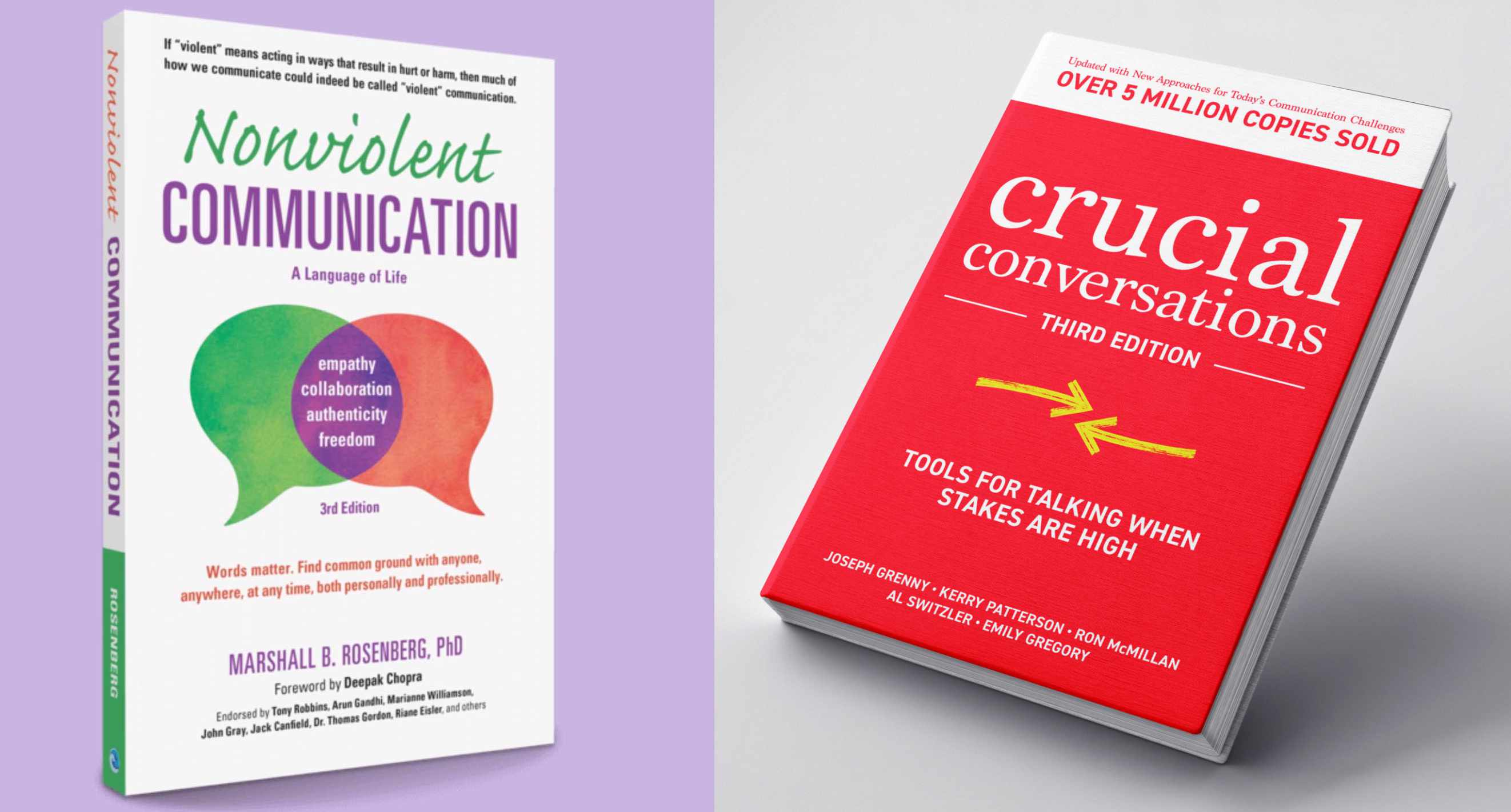
I’ve always recognized the significance of relationships and interpersonal dynamics. This understanding seems to resonate with the authors of the two books that I am comparing in this post, as they have devoted considerable effort to writing and publishing on this topic:

"When we first published Crucial Conversations in 2002, we made a bold claim. We argued that the root cause of many — if not most — human problems lies in how people behave when we disagree about high-stakes, emotional issues. We suggested that dramatic improvements in organizational performance were possible if people learned the skills routinely practiced by those who have found a way to master these high-stakes, crucial moments." (Grenny, Joseph; Patterson, Kerry; McMillan, Ron; Switzler, Al; Gregory, Emily. Crucial Conversations: Tools for Talking When Stakes are High, Third Edition (Preface, ix). References throughout the rest of this paper will be abbreviated to the format, "CC, page no.")
"Personal reality always contains a story, and the story we live, beginning from infancy, is based on language. This became the foundation of Marshall’s approach to conflict resolution, getting people to exchange words in a way that excludes judgments, blame, and violence." (Rosenberg, Marshall B.; Chopra, Deepak. Nonviolent Communication: A Language of Life: Life-Changing Tools for Healthy Relationships (Forward, xiii). References throughout the rest of this paper will be abbreviated to the format, "NVC, page no.")
"Believing that it is our nature to enjoy giving and receiving in a compassionate manner, I have been preoccupied most of my life with two questions: What happens to disconnect us from our compassionate nature, leading us to behave violently and exploitatively? And conversely, what allows some people to stay connected to their compassionate nature under even the most trying circumstances?" (Opening paragraph, NVC, 1)

The primary purpose of both books is to highlight the importance of navigating the complexity of our relationships using the only real tools we have to interact: through communication. While in some utopian future state we might evolve to communicate telepathically, for now, we are limited to language. Communication, however, involves more than just words. It’s important to recognize that when discussing communication, we are trying to convey the ideas that motivate and drive our actions.

"Each of us enters conversations with our own thoughts and feelings about the topic at hand. This unique combination makes up our personal pool of meaning. This pool not only informs us, but also propels our every action." (CC, 26)

Why this study?

I have been deeply engaged in studying Marshall Rosenberg’s book, Nonviolent Communication, for over six months. I am impressed with Rosenberg’s work and the insights and understanding it offers on how to address the root of any conflict I encounter. The practical tools provided for interacting in healthy and meaningful ways with others have been delightfully enlightening. In October, I shared my enthusiasm with a friend. He mentioned that it sounded much like a similar book on this subject titled Crucial Conversations. I had heard of this book. It had been recommended to me by several others over the years, but I had not yet managed to fit it into my reading schedule.

Rosenberg’s book has left me with a strong impression that what he provides are key principles, that once understood, I could use to measure the validity and utility of any other work about interpersonal communication. Naturally, I became curious about how the highly endorsed Crucial Conversations compares with Rosenberg’s Nonviolent Communication (hereafter abbreviated “NVC”). I told my friend that Crucial Conversations (hereafter abbreviated “CC”) had been on my reading list, so I committed to read it, compare the two, and share my findings with him. This post is the result of my study.

Get to the root before attempting to strategize solutions.

Most of our communication focuses on identifying what’s wrong, and then attempting to fix it.  Rosenberg, however, suggests that it’s not until we are able to identify our feelings and become aware of our true needs, can we begin to offer strategies for resolving differences. 

This idea is well put in his chapter on “Conflict Resolution and Mediation”:

"In my experience, connecting people at this level isn’t psychotherapy; it’s actually the core of mediation because when you make the connection, the problem solves itself most of the time. Instead of a third head asking, 'What can we agree to here?,' if we had a clear statement of each person’s needs — what those parties need right now from each other — we will then discover what can be done to get everybody’s needs met. These become the strategies the parties agree to implement after the mediation session concludes and the parties leave the room. When you make the connection, the problem usually solves itself." (NVC, 163-164)

Rosenberg’s NVC Process

The principle sounds simple enough, but a lot of practice is needed. We need to train ourselves how not to think judgmentally, or in other words, violently. Rosenberg’s NVC process involves focusing on four key areas:

"To arrive at a mutual desire to give from the heart, we focus the light of consciousness on four areas — referred to as the four components of the NVC model." (NVC, 6)

The four components of NVC 

  • The concrete actions we observe that affect our well-being 
  • How we feel in relation to what we observe 
  • The needs, values, desires, etc. that create our feelings 
  • The concrete actions we request in order to enrich our lives (NVC, 7)

These are the basics of the NVC model in a nutshell. Understanding how to employ them in your relationships will require study. I encourage readers to consult the book to fully appreciate its power. At its core, NVC teaches us to identify true needs. All humanity draws from the same pool of needs. Once we can identify each other’s true needs, we begin to see the common humanity we share. This often requires being vulnerable and recognizing our own and others’ feelings. Here is a list of common human needs:

  • Sustenance: Basic survival needs such as food, water, shelter, and rest.
  • Safety: Physical safety, security, and protection.
  • Love: Affection, intimacy, and emotional connection.
  • Understanding/Empathy: Being heard, understood, and receiving empathy.
  • Creativity: Opportunities for self-expression and creativity.
  • Recreation: Play, fun, and relaxation.
  • Belonging: A sense of community, acceptance, and connection with others.
  • Autonomy: Independence, freedom, and the ability to make choices.
  • Meaning: Purpose, contribution, and a sense of fulfillment (https://www.sociocracyforall.org/nvc-feelings-and-needs-list/).

Principles of Crucial Conversations

Here is a summary of the main principles outlined in Crucial Conversations:

  • Start with Heart: Focus on what you really want for yourself, others, and the relationship. Stay true to your goals and avoid getting sidetracked by emotions.
  • Learn to Look: Be aware of when a conversation becomes crucial. Pay attention to signs of stress or silence and recognize when safety is at risk.
  • Make It Safe: Create a safe environment for dialogue. Establish mutual purpose and mutual respect to ensure everyone feels comfortable sharing their views.
  • Master My Stories: Take control of your emotions by examining the stories you tell yourself. Separate facts from your interpretations and assumptions.
  • State My Path: Share your views clearly and confidently. Use facts and describe your perspective without exaggeration or judgment.
  • Explore Others’ Paths: Encourage others to share their views. Listen actively, ask questions, and show genuine interest in their perspectives.
  • Move to Action: Turn the conversation into action. Decide on next steps, assign responsibilities, and follow up to ensure accountability.

What are Feelings?

Crucial Conversations (CC) is filled with examples and practical advice on communication. It reads like a great motivational self-help book, backed by studies and years of experience from skilled practitioners of the CC method. I was able to identify the principles in CC and relate them to similar ideas in Rosenberg’s Nonviolent Communication (NVC). For example, CC emphasizes that being aware of one’s feelings is crucial for having an effective crucial conversation. In fact, chapter five in CC, “Master My Stories”, focus on this subject. It makes this important point:

"It’s important to get in touch with your feelings, and to do so, you may want to expand your emotional vocabulary." (CC, 87)

It was on seeing how CC dealt with the subject of feelings, that the key difference between the two books started to become evident.

An example is related in chapter three of CC, “Choose Your Topic”:

"I am the only nonwhite person on my team. I have been called by the wrong name multiple times in meetings by my immediate manager..."

Discussing ways for this person to decide how best to proceed, one option included:

"Talk relationship. Let your manager know that your name is an important part of your identity, and that you feel disrespected when someone you work with regularly doesn’t take the time to learn it. Or perhaps even more important, you feel disrespected by the suggestion that you change it." (CC, 44-45, emphasis mine)

Rosenberg would point out that “feeling disrespected” is not a true feeling:

"In NVC, we distinguish between words that express actual feelings and those that describe what we think we are.

Description of what we think we are:  
'I feel inadequate as a guitar player.' 
In this statement, I am assessing my ability as a guitar player, rather than clearly expressing my feelings.

Expressions of actual feelings:
'I feel disappointed in myself as a guitar player.' 
'I feel impatient with myself as a guitar player.' 
'I feel frustrated with myself as a guitar player.' 
The actual feeling behind my assessment of myself as 'inadequate' could therefore be disappointment, impatience, frustration, or some other emotion. 

Likewise, it is helpful to differentiate between words that describe what we think others are doing around us, and words that describe actual feelings." (NVC, 42)

On the following page, NVC provides a list of what we might call faux, or false feelings:

"Words like ignored express how we interpret others, rather than how we feel. Here is a sampling of such words:" (See NVC, 43)
abandonedco-optedmisunderstoodtaken for granted
abusedcorneredneglectedthreatened
attackeddiminishedoverworkedunappreciated
betrayeddistrustedpatronizedunheard
boxed-ininterruptedpressuredunseen
bulliedintimidatedprovokedunsupported
cheatedlet downput downunwanted
coercedmanipulatedrejectedused

How CC deals with the topic of feelings is elaborated on in chapter five:

"Actually, identifying your emotions is more difficult than you might imagine. In fact, many people are emotionally illiterate. When asked to describe how they’re feeling, they use words such as “bad” or “angry” or “scared” — which would be OK if these were accurate descriptors, but often they’re not. Individuals say they’re angry when, in fact, they’re feeling a mix of embarrassment and surprise. Or they suggest they’re unhappy when they’re feeling violated. Perhaps they suggest they’re upset when they’re really feeling humiliated and hurt. 
Since life doesn’t consist of a series of vocabulary tests, you might wonder what difference words can make. But words do matter. Knowing what you’re really feeling helps you take a more accurate look at what is going on and why. For instance, you’re far more likely to take an honest look at the story you’re telling yourself if you admit you’re feeling both embarrassed and surprised rather than simply angry.
When you take the time to precisely articulate what you’re feeling, you begin to put a little bit of daylight between you and the emotion. This distance lets you move from being hostage to the emotion to being an observer of it. When you can hold it at a little distance from yourself, you can examine it, study it, and begin to change it. But that process can’t begin until you name it.
How about you? When experiencing strong emotions, do you stop and think about what you’re feeling? If so, do you use a rich vocabulary, or do you mostly draw from terms such as ‘OK,’ ‘bummed out,’ ‘ticked off,’ or ‘frustrated’? Second, do you talk openly with others about how you feel? Do you willingly talk with loved ones about what’s going on inside you? Third, in so doing, do you take the time to get below the easy-to-say emotions and accurately identify those that take more vulnerability to acknowledge (like shame, hurt, fear, and inadequacy)?
It’s important to get in touch with your feelings, and to do so, you may want to expand your emotional vocabulary." (CC, 86-87, emphasis mine)

CC nails it, while at the same time missing a crucial point that using a counterfeit feeling like “violated” is not a true feeling. This is a significant distinction in NVC. As pointed out above, words like “violated” and “humiliated” are evaluative words, not true feelings. Being “violated” invokes some form of judgement that would require a “violator.” For one to be “humiliated” requires there be a “humiliator.” Use of such terms increases defensiveness and resistance.

"A common confusion, generated by the English language, is our use of the word feel without actually expressing a feeling. For example, in the sentence, 'I feel I didn’t get a fair deal,' the words I feel could be more accurately replaced with I think. In general, feelings are not being clearly expressed when the word feel is followed by:

Words such as that, like, as if:
'I feel that you should know better.' 
'I feel like a failure.'
'I feel as if I’m living with a wall.' 

The pronouns I, you, he, she, they, it:
'I feel I am constantly on call."
'I feel it is useless.'

Names or nouns referring to people:  
'I feel Amy has been pretty responsible.' 
'I feel my boss is being manipulative.' 

Conversely, in the English language, it is not necessary to use the word feel at all when we are actually expressing a feeling: we can say, 'I’m feeling irritated,' or simply, 'I’m irritated.'" (NVC, 41)

Building a Vocabulary for Feelings

CC encourages we expand our emotional vocabulary. NVC takes it further by compiling lists to help increase our power to articulate feelings and clearly describe a whole range of emotional states.

Feelings (Emotions) when Needs are Met

AFFECTIONATEEXCITEDGRATEFULPEACEFUL
compassionateamazedappreciativecalm
friendlyanimatedmovedcentered
lovingardentthankfulclear headed
open heartedarousedtouchedcomfortable
sympatheticastonished content
tenderdazzledHOPEFULequanimous
warmeagerexpectantfulfilled
 energeticencouragedmellow
CONFIDENTenthusiasticoptimisticquiet
empoweredgiddy relaxed
openinvigoratedINSPIREDrelieved
proudlivelyamazedsatisfied
safepassionateawedserene
securesurprisedwonderstill
 vibrant tranquil
ENGAGED JOYFULtrusting
absorbedEXHILARATEDamused 
alertblissfuldelightedREFRESHED
curiousecstaticgladenlivened
enchantedelatedhappyrejuvenated
engrossedenthralledjubilantrenewed
entrancedexuberantpleasedrested
fascinatedradianttickledrestored
interestedrapturous revived
intriguedthrilled  
involved   
spellbound   
stimulated   

Feelings (Emotions) when Needs are NOT Met

AFRAIDCONFUSEDEMBARRASSEDSAD (cont.)
apprehensiveambivalentashamedheavy hearted
dreadbaffledchagrinedhopeless
forebodingbewilderedflusteredmelancholy
frighteneddazedguiltyunhappy
mistrustfulhesitantmortifiedwretched
panickedlostself-conscious 
petrifiedmystified TENSE
scaredperplexedFATIGUEanxious
suspiciouspuzzledbeatcranky
terrifiedtornburnt outdistressed
wary depleteddistraught
worriedDISCONNECTEDexhaustededgy
 alienatedlethargicfidgety
ANGRYalooflistlessfrazzled
enragedapatheticsleepyirritable
furiousboredtiredjittery
incensedcoldwearynervous
indignantdetachedworn outoverwhelmed
iratedistant restless
lividdistractedPAINstressed out
outragedindifferentagony 
resentfulnumbanguishedVULNERABLE
 removedbereavedfragile
ANNOYEDuninteresteddevastatedguarded
aggravatedwithdrawngriefhelpless
disgruntled heartbrokeninsecure
dismayedDISQUIEThurtleery
displeasedagitatedlonelyreserved
exasperatedalarmedmiserablesensitive
frustrateddiscombobulatedregretfulshaky
impatientdisconcertedremorseful 
irkeddisturbed YEARNING
irritatedperturbedSADenvious
 rattleddejectedjealous
AVERSIONrestlessdepressedlonging
animosityshockeddespairnostalgic
appalledstartleddespondentpining
contemptsurpriseddisappointedwistful
disgustedtroubleddiscouraged 
disliketurbulentdisheartened 
hateturmoilforlorn 
horrifieduncomfortablegloomy 
hostileuneasy  
repulsedunnerved  
 unsettled  
 upset  

The Need for Safety

CC emphasizes the need to recognize when safety is at risk. 

"If what we’re suggesting here is true, then the problem is not the message. The problem is that you and I fail to help others feel safe hearing the message. If you can learn to see when people start to feel unsafe, you can take action to fix it. That means the first challenge is to simply see and understand that safety is at risk." (CC, 112, emphasis mine)

Here CC has identified what could either be a common human need for “safety”, or an actual feeling, that of feeling “safe,” (which could likewise be expressed as feeling “confident,” “empowered,” or “secure”). On the other hand, if used as an expression of a universal human need, this would be another example that Rosenberg identifies in NVC, of the common confusion generated by the English language where the word feel is used without expressing a feeling.

In NVC it is an important distinction to be able to separate feelings from needs in order to truly connect with ourselves and others. Rosenberg points out in the opening chapter of NVC:

"NVC guides us in reframing how we express ourselves and hear others. Instead of habitual, automatic reactions, our words become conscious responses based firmly on awareness of what we are perceiving, feeling, and wanting. We are led to express ourselves with honesty and clarity, while simultaneously paying others a respectful and empathic attention. In any exchange, we come to hear our own deeper needs and those of others." (NVC, 3, emphasis mine)

In my own experience with learning NVC, the challenge of “reframing” has not been easy. It has taken a conscious practice to increase my awareness and vocabulary around feelings and needs, but the results have had a profound effect on my ability to navigate difficult conversations. 

Earlier in the book, CC pointed out how:

"No matter how comfortable it might make you feel to say it, others don’t make you mad. You make you mad. You make you scared, annoyed, insulted, or hurt. You and only you create your emotions." (CC, 75)

NVC also confirms this idea:

"Another kind of life-alienating communication is denial of responsibility. Communication is life-alienating when it clouds our awareness that we are each responsible for our own thoughts, feelings, and actions. The use of the common expression have to, as in 'There are some things you have to do, whether you like it or not,' illustrates how personal responsibility for our actions can be obscured in speech. The phrase makes one feel, as in 'You make me feel guilty,' is another example of how language facilitates denial of personal responsibility for our own feelings and thoughts." (NVC, 19)

It is an important distinction to point out what CC is NOT saying. To the extent that we may imply that by our words we can “make” others “feel unsafe”, we imply something that is fundamentally untrue.

Earlier in this post we listed some common human needs that were identified in NVC. To the degree that CC treats safety as common human need, making it the main object is to prioritize it over other fundamental human needs. In practice, it is a difficult thing to learn the art of identifying needs. For me, I think prioritizing the need for safety over other equally important needs would hinder the intent of NVC to get to the true root needs. This is one reason I find focusing on the NVC approach to communicating much preferred over the model presented in CC.

What About Violence?

The final point I would like to make is to examine how the two books treat the topic of violence. 

In CC violence gets defined:

"Violence consists of any verbal strategy that attempts to convince or control others or compel them to your point of view. It violates safety by trying to force meaning into the pool. Methods range from name-calling and monologuing to making threats." (CC, 117)

In NVC, “violence” is rooted in judgement. The concept is based on what one instructor of the NVC method referred to as the “John Wayne effect.” In this scenario, if you walk into a bar and meet someone who is a good guy, you buy him a beer. If he’s a bad guy, you either beat him up or shoot him:

"The relationship between language and violence is the subject of psychology professor O.J. Harvey’s research at the University of Colorado. He took random samples of pieces of literature from many countries around the world and tabulated the frequency of words that classify and judge people. His study shows a high correlation between frequent use of such words and frequency of incidents. It does not surprise me to hear that there is considerably less violence in cultures where people think in terms of human needs than in cultures where people label one another as ‘good’ or ‘bad’ and believe that the ‘bad’ ones deserve to be punished. In 75 percent of the television programs shown during hours when American children are most likely to be watching, the hero either kills people or beats them up. This violence typically constitutes the ‘climax’ of the show. Viewers, having been taught that bad guys deserve to be punished, take pleasure in watching this violence." (NVC, 17-18)

When our words are framed as blame or judgement, they become what Rosenberg calls “life-alienating,” which blocks compassion:

"Such judgments are reflected in language: 'The problem with you is that you’re too selfish.' 'She’s lazy.' 'They’re prejudiced.' 'It’s inappropriate.' Blame, insults, put-downs, labels, criticism, comparisons, and diagnoses are all forms of judgment. The Sufi poet Rumi once wrote, 'Out beyond ideas of wrongdoing and right-doing, there is a field. I’ll meet you there.' Life-alienating communication, however, traps us in a world of ideas about rightness and wrongness — a world of judgments." (NVC, 15-16)

So, to compare the two ideas, in CC violence “consists of a verbal strategy that attempts to force meaning into the pool,” whereas in NVC violence is the result of judgements that classify and label one another as “good” or “bad” where the “bad” ones deserve to be punished. Let me frame this as a question. To the degree that in NVC the word violence takes on a different meaning than how it is used in CC, is CC attempting to force a different meaning for this word into the pool, making its use of the word, by its own definition, a form of violence in itself?

From an NVC perspective, the key would be how the concept is communicated. If CC uses the term “violence” in a way that promotes empathy, understanding of underlying needs, and invites connection, it might not be seen as violence by NVC standards. But if it leads to judgment, blame, or disconnection, then one could argue it’s moving towards what NVC would consider violent communication.

Making Requests

One component of the NVC model is requesting that which would enrich life. Recall the four components of NVC:

  1. Observation
  2. Feelings
  3. Needs
  4. Requests. (See NVC, 6-7)

It’s typical for us to not want to have needs. We don’t want to be needy. We don’t want to expose ourselves to be vulnerable as someone with needs. Learning to ask for what I want has possibly been the most difficult part for me in learning and practicing NVC. The idea of making requests of others for what we need is an important element of the NVC model. NVC dedicates a chapter on “Requesting That Which Would Enrich Life”: 

"We have now covered the first three components of NVC, which address what we are observing, feeling, and needing. We have learned to do this without criticizing, analyzing, blaming, or diagnosing others, and in a way likely to inspire compassion. The fourth and final component of this process addresses what we would like to request of others in order to enrich life for us. When our needs are not being fulfilled, we follow the expression of what we are observing, feeling, and needing with a specific request: we ask for actions that might fulfill our needs. How do we express our requests so that others are more willing to respond compassionately to our needs?" (NVC, 67)

To me this idea of making a request for my own needs is not expressly evident in CC, except where the authors identify the importance of determining what we really want:

"Choosing is a matter of filtering all the issues you’ve teased apart through a single question: 'What do I really want?'" (CC, 47-48)
"Clarity is crucial. But so is flexibility. Remember, this isn’t a monologue. It should be a dialogue. There are other people in this conversation, and they have their own wants and needs. In some Crucial Conversations, new issues will come up, and you need to balance focus (on your goals) with flexibility (to meet their goals)." (CC, 52)

Are you ask’n or tell’n?

Have you ever had someone make a request of you where you felt drawn to have them clarify (whether you actually expressed it out loud), “Are you asking me or are you telling me? Because if you are telling me, the answer is no.” 

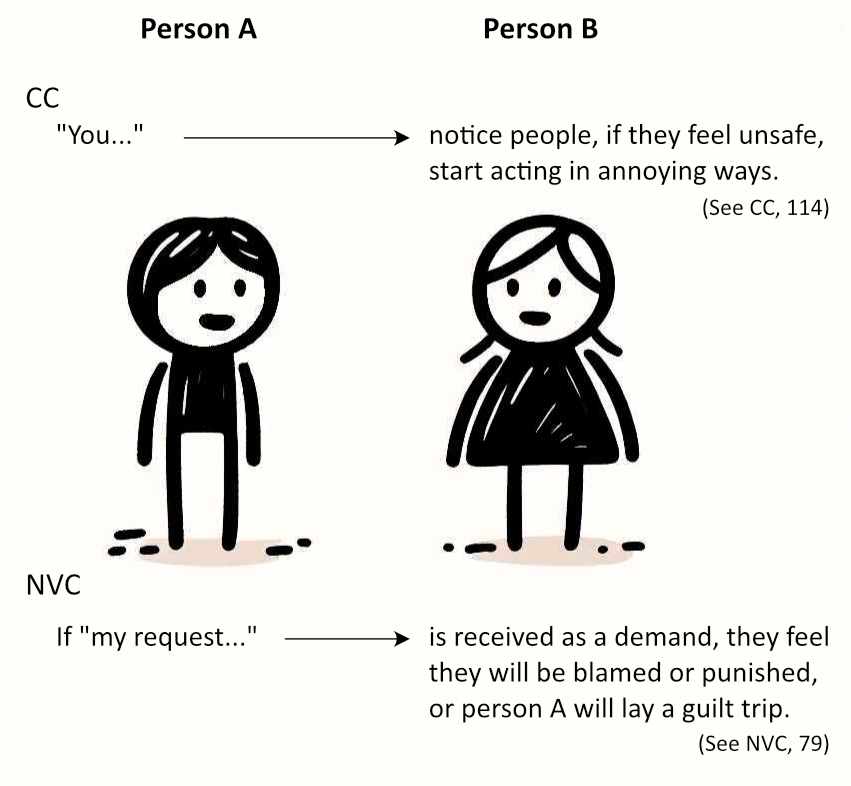
It seems to be a built-in human condition to resist being bossed around. In NVC, respect, acceptance, trust, and cooperation are examples of common human needs. NVC has a section in chapter six on “Requests versus Demands”:

"Our requests are received as demands when others believe they will be blamed or punished if they do not comply. When people hear a demand, they see only two options: submission or rebellion. Either way, the person requesting is perceived as coercive, and the listener’s capacity to respond compassionately to the request is diminished." (NVC, 79)

The response others give to us when they perceive our request as a demand, appears to be the subject of what the CC model identifies as “feeling unsafe”:

"When others begin to feel unsafe, they start acting in annoying ways. They may make fun of you, insult you, or steamroll you with their arguments. In such moments, you should be thinking to yourself: 'Hey, they’re feeling unsafe. I need to do something — maybe make it safer.'" (CC, 114)

We see this idea emerge in how CC uses the terms silence and violence: 

"Learn to identify the two kinds of behavior that will clue you in to the fact that someone’s feeling unsafe. We refer to them as silence and violence." (CC, 115)

NVC identifies two kinds of behavior when the other person perceives our request as a demand:

  • When the other person hears a demand from us, they see two options: to submit or to rebel.
  • To tell if it’s a demand or a request, observe what the speaker does if the request is not complied with.
  • It’s a demand if the speaker then criticizes or judges. (Or lays a guilt trip)
  • It’s a request if the speaker then shows empathy toward the other person’s needs. (See NVC, 79-80)

Where CC encourages “rebuilding safety,” NVC encourages “showing empathy”:

"When safety is at risk and you notice people moving to silence or violence, you need to step out of the content of the conversation (literally stop talking about the topic of your conversation) and rebuild safety." (CC, 133)

In NVC empathy is something that we may need to show toward others when we become aware that they perceive our request as a demand. Empathy is also something we may need to give to ourselves:

"We need empathy to give empathy. When we sense ourselves being defensive or unable to empathize, we need to (1) stop, breathe, give ourselves empathy; (2) scream nonviolently; or (3) take time out." (NVC, 104)

In CC the focus is on identifying the kinds of behavior exhibited by others that clue us in to when they may be feeling unsafe, so that we can then take steps to “make it safe” (See CC, 127). NVC wants us to recognize that we ourselves are just as likely to be the ones who need safety1:

"The more we have in the past blamed, punished, or 'laid guilt trips' on others when they haven’t responded to our requests, the higher the likelihood that our requests will now be heard as demands. We also pay for others’ use of such tactics. To the degree that people in our lives have been blamed, punished, or urged to feel guilty for not doing what others have requested, the more likely they are to carry this baggage to every subsequent relationship and hear a demand in any request." (NVC, 79)

Conclusion

Ultimately, the objective in both books is to give us tools to navigate the complexity of our relationships through improving how we communicate with others. This study has left me convinced that the effort I have spent in trying to master the tools of NVC has not been wasted. Though CC offers a great method on how to approach difficult conversations when stakes are high, for me NVC gets me closer to the heart of my true intent, in fact, my true “need,” for heartfelt connection with others. Once that can be attained, the issues that divide us tend to resolve themselves.  From the chapter “Conflict Resolution and Mediation,” Rosenberg puts it this way:

"My experience has taught me that it’s possible to resolve just about any conflict to everybody’s satisfaction. All it takes is a lot of patience, the willingness to establish a human connection, the intention to follow NVC principles until you reach a resolution, and trust that the process will work.
In NVC-style conflict resolution, creating a connection between the people who are in conflict is the most important thing. This is what enables all the other steps of NVC to work, because it’s not until you have forged that connection that each side will seek to know exactly what the other side is feeling and needing. The parties also need to know from the start that the objective is not to get the other side to do what they want them to do. And once the two sides understand that, it becomes possible — sometimes even easy—to have a conversation about how to meet their needs." (NVC, 161-162)

  1. I think the ideas are presented sufficiently clear as stated above, but here in this footnote I explore the interpersonal interactions between the two models (CC and NVC) a little further:

    Silence or Violence, Submit or Rebel


    From CC Perspective
    Person A identifies when “safety is at risk” when Person B responds in silence or violence (acts in “annoying ways”). You also want to be aware of your own behavior, “your style under stress” (see CC, 120). Are you interacting with silence or violence yourself?

    From NVC Perspective
    It’s not, How do I know Person B feels “safe or unsafe”. In NVC that’s not the question. In NVC the question is how does Person B know Person A is making a request or a demand? The answer is if Person A is judging or criticizing or blaming or laying a guilt trip. In words of CC, it is responding with silence (for example a guilt trip) or with violence (for example criticizing or blaming). If it is a demand, Person B is left to respond by either submitting or rebelling (which can be considered a form of silence or violence itself).

    Defensiveness
    In CC people who feel unsafe become defensive because of one of two reasons:

    “You first need to understand why someone feels unsafe. People never become defensive about what you’re saying (the content of your message). They become defensive because of why they think you’re saying it (the intent). Said another way, safety in a conversation is about intent, not content. When people become defensive, it is because either:
    1. You have a bad intent toward them (and they are accurately picking up on that).
    Or:
    2. They have misunderstood your good intent.” (CC, 133)

    Similarly, in NVC a person may feel they have only two options (submit or rebel) when they become aware the request is actually a demand. NVC encourages us to remove judgement (whether the “intent” is “good” or “bad”), and focus instead on using empathy to open and connect with each other and ourselves in a way that allows our natural compassion to flourish. In the case of Person A that might be to become aware of his own demanding language and change something about his approach using empathy. In the case of Person B that might be to sense the “submit or rebel” instinct that arises within her and let him know how she feels and how the demand he is making does not meet her needs. In NVC there are not just two options or reasons for defensiveness. “Safe” and “unsafe” are among many feelings one may experience. Safety is only one of many other needs we may have. There are more than only two reasons for resistance, defensive, and aggressive reactions. ↩︎

Jay’s Learning Model Revisited

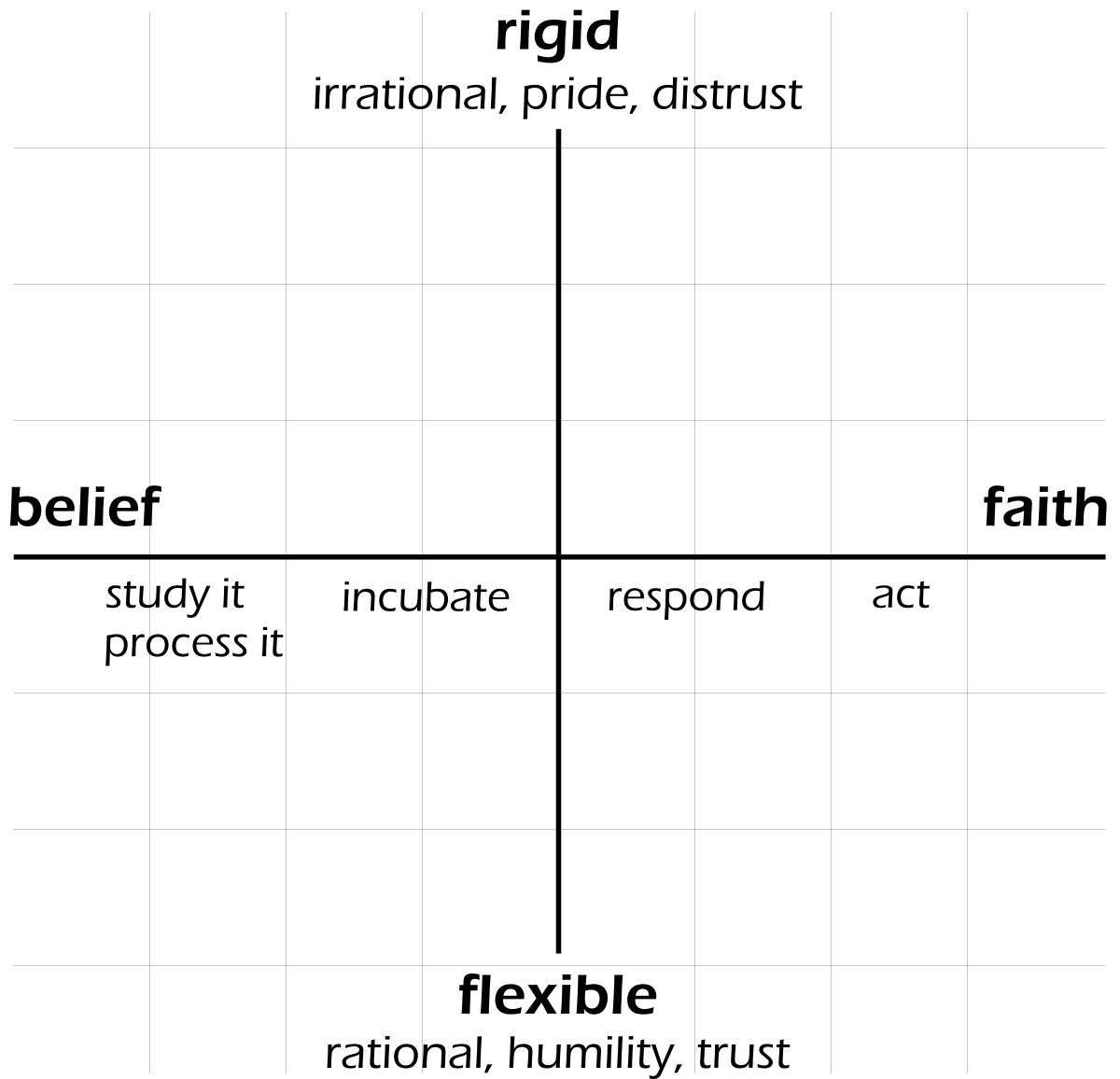
The purpose of this model is to have a tool that can be used to evaluate a faith-based approach to learning.

This model is an updated version of the one originally published on September 9, 2020. See blog post Living Polar Bears and Dead Frogs – My Learning Model.

The purpose of this model is to have a tool that can be used to evaluate a faith-based approach to learning. There are two key statements that formed the inspiration behind the model.

The first statement is:

“A position that begins with an inflexible1 conclusion and seeks ‘evidence’ to support it is impervious to reason”

Steve Cuno

This statement forms the top and bottom of the model separated by the horizontal axis, with “rigid” at the top and “flexible” at the bottom. As the statement describes, it is rather impossible to learn anything new unless one is flexible enough to receive it.

The second statement is:

“And as all have not faith, seek ye diligently and teach one another words of wisdom; yea, seek ye out of the best books words of wisdom; seek learning, even by study and also by faith.”

D&C 88:118

This statement forms the left and right of the model separated by the vertical axis, with “faith” on the right. On the left I have placed the word “belief”. Not because “belief” is the opposite of “faith,” but because the purpose of the model is to emphasize that the preferred method of learning new truth is through “faith.” But as not everyone can easily approach learning from a place rooted in true faith, then (as the scripture indicates) the next best method is to approach it through study that can then lead to, or draw one toward, true faith.

To best comprehend what the model is communicating, it is important to understand that for the purpose of this model faith is being defined as something that is more than belief; a principle of action that requires one to act on belief in order to produce faith. Faith is being defined as a principle of power through action, in which one puts those beliefs into action and thereby acquires power. One can spend a lifetime as a “believer”2 without ever developing faith. Before belief can turn into faith, action is required. Without some action consistent with belief, a disciple cannot move along from mere belief to developing faith. It is action, obedience, and living in conformity to God’s will that yields faith.3

The movement from “belief” on the left toward “faith” on the right represents a section of points along a spectrum. Somewhere to the left of “belief” would include “doubt” and “unbelief”. To the right of “faith” would move one toward “knowledge”. Though he is not using the same vocabulary, Paul describes the process in these words:

“…suffering produces perseverance; perseverance, character; and character, hope.”

Rom 5:3-4. NIV
  1. The word “inflexible” has been added to the original statement so that it more correctly reflects truth. ↩︎
  2. Not in the sense used in Evangelical Christianity describing a saved brother or sister, but in the sense being described in the model. ↩︎
  3. Though you have not seen him, you love him; and even though you do not see him now, you believe in him and are filled with an inexpressible and glorious joy, for you are receiving the end result of your faith, the salvation of your souls.” (1 Peter 1:8-9. NIV) ↩︎

Buddhist Definition of Faith

What Does It Mean to Have “Deep Faith”?

In Nichiren Buddhism the most important of Buddha’s teachings is found in the Lotus Sutra.

The twelfth century Japanese Buddhist priest, Nichiren, taught that one can attain Buddhahood in this lifetime by chanting what is essentially the title of the Lotus Sutra, “Nam-myoho-renge-kyo.”

The Japanese title of the Lotus Sutra (daimoku) depicted in a stone inscription.

The qualifier Nichiren gives that activates the power of Nam-myoho-renge-kyo is “deep faith.”:

“If you chant Myoho-renge-kyo with deep faith in this principle, you are certain to attain Buddhahood in this lifetime.”

(Writings of Nichiren Daishonin, Volume 1, page 4. Hereafter abbreviated “WND-1, page number.”)

What Does It Mean to Have “Deep Faith”?

To answer this question, and to avoid imposing ideas from my own culture and background, I sought to understand faith from the Buddhist point of view by turning to the Lotus Sutra. From my research I was able to identify this following definition based on a study of “faith” as found in the Lotus Sutra:

Faith is something that needs to be developed and cultivated1. It causes one to change direction.2 It is a principle of power.3 Failure to have faith is destructive,4 meaning that faith is a constructive force. The overbearing and arrogant ones lacked it.5 Doubt and perplexity are its opposite.6 It was through “faith alone”7 that Shariputra was able to gain entrance. Being able to comply with the sutra was because of faith in the Buddha’s words, not because of “any wisdom of their own”.8

  1. “Persons will be able to develop minds of faith, abruptly changing their direction.” (The Lotus Sutra and Its Opening and Closing Sutras, p.27. Hereafter abbreviated “LSOC, page number.”) ↩︎
  2. Ibid. ↩︎
  3. “Among the other kinds of living beings there are none who can comprehend it, except the many bodhisattvas who are firm in the power of faith. (LSOC, 58)
    “These people will possess the power of great faith, the power of aspiration, the power of good roots.”
    (LSOC, 204)
    “If the thus come one knows that the time has come to enter nirvana, and knows that the members of the assembly are pure and clean, firm in faith and understanding…”
    (LSOC, 173)
    “Shariputra, you should know that the words of the various buddhas never differ. Toward the Law preached by the buddhas you must cultivate a great power of faith.”
    (LSOC, 59)
    From these above passages we learn that faith is a principle of power. It requires firmness and is associated with understanding. ↩︎
  4. “If a person fails to have faith but instead slanders this sutra, immediately he will destroy all the seeds for becoming a buddha in any world.” (LSOC, 110) ↩︎
  5. “There are monks and nuns who behave with overbearing arrogance, laymen full of self-esteem, laywomen who are lacking in faith.” (LSOC, 67) ↩︎
  6. “When the buddha preached this sutra, the sixteen bodhisattva shramaneras all took faith in it and accepted it, and among the multitude of voice-hearers there were also those who believed in it and understood it. But the other thousand ten thousand million types of living beings all gave way to doubt and perplexity.” (LSOC, 171) ↩︎
  7. From the Simile and Parable (chapter three) we learn from the Buddha’s words to Shariputra:
    “Even you, Shariputra, in the case of this sutra were able to gain entrance through faith alone. How much more so, then, the other voice-hearers. Those other voice-hearers—it is because they have faith in the Buddha’s words that they can comply with this sutra, not because of any wisdom of their own.” (LSOC, 109-10)
    Nichiren explains this passage:
    “This passage is saying that even Shāriputra, who was known for his great wisdom, was, with respect to the Lotus Sutra, able to gain entrance through faith and not through the power of his wisdom. How much more so, therefore, does this hold true with the other voice-hearers!” (WND-1, 132)  ↩︎
  8. Ibid. ↩︎